

the haze
what survives

There is a particular kind of despair that comes from loving history too much.
Not the broad, theatrical despair of wars and collapses and all the obvious tragedies people gesture toward when they talk about “the past,” but a smaller, stranger despair of realizing how unevenly human beings survive.
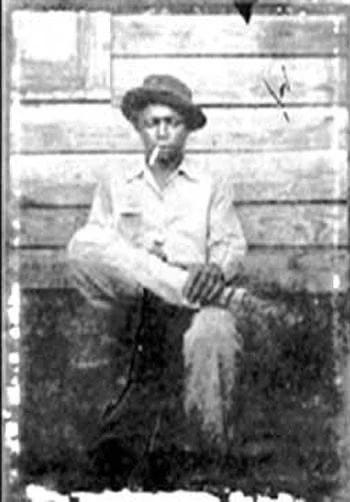
Lately, I cannot stop thinking about Henry Sloan.
Which is difficult, because there are so few facts to think about.
A sharecropper at Dockery Plantation in Mississippi. Probably the earliest architect of the Delta Blues. The greatest influence on Charley Patton — or Charlie, depending on which source you trust. Which feels almost absurd in a way I cannot stop dwelling on. We do not even fully know how to spell the name of one of the foundational figures of the Delta Blues, let alone much about the man who taught him to play.
There is one photograph of Sloan that exists. Maybe the only one ever taken. Grainy. Indistinct.
But still there is the music.
I listen to Muddy Waters every day. Howlin’ Wolf while driving. Music that feels so enormous, so permanent, so woven into American culture that it is hard to imagine a world without it. And yet if you follow the lineage backward far enough, everything starts disappearing.
The people become a haze.
I do not know exactly why this unsettles me so much.
Part of it, I think, is that I work with archives. Or maybe “work with” is too gentle a phrase. I spend most of my life thinking about preservation. What gets saved. What gets lost. Which stories become fixed and which begin to fray at the edges almost immediately.
And the truth is, the archive does not feel neutral to me anymore.
Sometimes it feels miraculous.
Sometimes it feels violent.
Because meanwhile, we know exactly why Samuel Morse devoted himself to inventing the telegraph. The story survives in almost cinematic detail: his pregnant wife became ill while he was away, the messenger arrived too late, and by the time he returned home, she had already been buried. Grief altered the course of his life. Delay became intolerable to him.
And something about that overwhelmed me when I learned it.
Not the tragedy itself, exactly, but the clarity of it. The strange privilege of being able to see someone across centuries with such precision. Suddenly, he stopped being Samuel Morse, inventor of the telegraph, and became a husband frantic with grief and helplessness. I could understand the trajectory of his life emotionally. Cause and effect collapsed into something painfully universal.
I am grateful for that kind of historical intimacy. Truly. There is something remarkable about reaching backward through time and not just learning what happened to someone, but understanding what it did to them.
Which is why the imbalance unsettles me so much.
One man’s grief survives.
Another man helped create one of the most influential musical traditions, and endures mostly as rumor and influence and one blurred photograph.
I don’t know what to do with that.
I don’t know if there is anything to do with that.
Maybe this unevenness is simply the natural condition of history — the haves vs. the have nots. Or maybe that is too innocent a way of describing it.
Because some things vanish accidentally. Time erodes them. Paper burns. Names get misspelled. People die before anyone thinks to ask questions.
But other histories are deliberately neglected. Dismissed. Underfunded. Deemed unworthy of preservation long before they have the chance to become “history” at all.
Because every archive on earth is partially a monument to life and partially a record of power — of who was allowed to become legible in the first place.
Or maybe I am overromanticizing absence because I cannot bear it.
I honestly do not know.
What I do know is that I keep returning to the fact that Henry Sloan survived at all.
Just traces.
A man making sound.
And somehow that sound traveled anyway.
Through fields and front porches and juke joints and records and radios and highways and decades. Into Muddy Waters. Into Howlin’ Wolf. Into the Rolling Stones. Into me, sitting in traffic nearly a century later with the windows down, feeling absurdly alive because someone I will never know once picked up a guitar.
I think that’s the part that fills me with both grief and joy.
That grand, miraculous beings have always existed. That they disappear so easily.
That any of us can disappear that easily.
That sometimes you have to squint to see the footprints they left behind. Or the ghosts still flitting about.
Sometimes I think history is proof of humanity’s brilliance.
Sometimes I think it is proof of humanity’s indifference.
Most days, I think it is both at once.


If you made it this far, click that itty-bitty digital organ! ❤️
Caroline, you are such a thoughtful writer. I loved this little slice of blues education and I love that you listen to Muddy on your drives. It is baffling to consider what we continue to revere and what slips away. I learned about Sister Rosetta Tharpe and Ma Rainey and Big Mama Thornton when I was a counselor at a girls music camp. I couldn't believe that I hadn't found them until I was an adult. Thanks for bringing some Caroline gospel to my Sunday morning :)
so glad you wrote this. 🙏🏼