

comfortably numb
on our addiction to simple stories

It’s 2020, and I’m up late working on my thesis — the kind of late where your brain starts picking fights with shadows. Exhausted by academic papers on postwar media, I let streaming recommendations guide me until I land on Makers: Women Who Make America (2013). I’m watching, intrigued, until Gloria Steinem looks dead into the camera and drops this: “I don’t remember any actual serious, smart women in television” in the 1950s. My body heats up, not just with rage, but specific rage: the kind reserved for simplistic arguments delivered with bulletproof confidence. Because, of course, there were serious, smart women on television in the 1950s — you just have to look past the surface.
In sitcoms and variety shows, in pioneering news programs and children’s television, women were carving out spaces of surprising agency and intellectual heft. But I guess complexity doesn’t make for good soundbites, and it’s easier to dismiss an entire decade of television history than to grapple with the inconvenient truth of its contradictions: how the same medium that gave us June Cleaver in pearly perfection also gave us Gertrude Berg writing, producing, and starring in her own show about the raw struggles of middle-class American life.

That fucking quote wouldn’t leave me alone. It burrowed under my skin because I took it personally. At the time, I was neck-deep in my thesis, arguing that women like Arlene Francis — a television pioneer who’s been effectively erased from history — had managed to both confirm and upend every stereotype of what a 1950s woman should be. My entire argument hinged on the layers and inconsistencies of these figures. I didn’t need Gloria shooting holes in it before my defense date! But of course she came to that conclusion — why wouldn’t she? The 1950s were practically a PhD program in how to portray women as decorative airheads, and nuance wasn’t exactly winning any popularity contests back then.
The thing is, the 1950s didn’t lack smart, serious women. What it lacked was any interest in recognizing the women who were already there, quietly dismantling expectations while everyone else was busy polishing their white picket illusions.
But this isn’t about Gloria. Or Arlene. Or even the 1950s. It’s about us. We’re the ones who keep reaching for the broad strokes and the tidy narratives, who keep sanding down history’s rough edges. We’re addicted to our hot takes and easy answers — our shortcut to feeling righteous, our drive-thru window to understanding the world. And it’s a betrayal of everyone who dared to be difficult.
Circling back to Arlene — when we remember her at all, we reduce her to “that charming host,” as if charm were some kind of crime. Never mind that she was a goddamn force of nature who helped shape television itself, who proved you could be both razor-sharp and magnetic. Or look at Cleopatra, forever trapped in history’s amber as some kind of ancient femme fatale, while her masterful political strategy and empire-building get buried in footnotes. Or consider Ada Lovelace, diminished to “Byron’s daughter” when she was writing computer algorithms before computers even existed, imagining possibilities that wouldn't be realized for another century. We don’t just simplify — we sanitize, cutting away everything that makes these figures human until they’re nothing but watered-down symbols for whatever story we’re trying to sell.
And here’s the real kick in the teeth: this reductionism is a con job we’re pulling on ourselves. We’ve convinced ourselves that breaking everything down to its most basic parts somehow brings clarity, when all it really does is flatten the landscape until nothing wild can survive. It’s like smashing a stained-glass window into shards and saying, “Look, it’s just a pile of glass.” Technically true, but you’ve murdered the magic.
We keep doing this because it feels safe. It’s comforting to sort the world into neat little bins: heroes and villains, visionaries and sellouts, revolutionaries and reactionaries. We stay comfortably numb within these categories — they’re like painkillers dulling reality. But reality refuses to play along. It spills over every boundary we try to draw, shatters every box we try to build. And I’m grateful for that, because that messiness — those gray areas, those moments when someone or something refuses to be what we expect — that’s where all the good stuff lives.
Instead, we’ve become masters of the oversimplified narrative, turning movements into hashtags and people into plot points. We take the seasoning out of history and then wonder why it tastes like cardboard. We’re so desperate to make sense of the world that we’re willing to sacrifice its excitement on the altar of effortless understanding. And what we lose in the bargain is nothing less than the sensitive, untamed, electrifying chaos that makes life worth examining in the first place.
I know. I'm being annoying and preachy about this. But stay with me a little longer.
So we’re reductive. What the hell do we do about it?
Maybe the first step is just owning it — admitting that we all do this, not because we’re lazy or malicious, but because sometimes it’s easier to swallow a lie than choke on the truth. But “easier” is just another word for “settling,” and I don't know about you, but I’m done settling for stories that arrive flavorless.
Because here’s what I’ve learned: the stories that haunt you — the ones that follow you into your dreams and ambush you in quiet moments — they’re never the simple ones. They’re collages of differences and intricacy, full of points that draw blood. They’re the stories that demand something from you — your attention, your doubt, your willingness to stand in the shadow of what you don’t understand and just... stay there for a while.
And that includes our individual stories. Because we don’t just reduce history or other people — we do it to ourselves. We glaze over the cracks and rewrite our lives into something that feels more palatable. But life’s too short to star in a dumbed-down version of your own story just because it fits neater on a page.
Look, we’re never going to break free of our reductive habits entirely (spoiler alert: our brains are hardwired for shortcuts). But we can get better at catching ourselves in the act. We can pause when we’re reaching for the easy answer and ask: What am I erasing? What truths am I burying? What parts of the story make me squirm?
And then, instead of settling for the mental equivalent of fast food, we can choose to stay with the mess. To let the commotion exist. To let the contradictions breathe.
Because when we finally stop trying to hack the world into digestible pieces — when we let it be as feral and thorny and complicated as it really is — that’s when things get interesting.
And isn’t that the whole point?
It’s the reductionist approach to life: if you keep it small, you’ll keep it under control. If you don’t make any noise, the bogeyman won’t find you. But it’s all an illusion, because they die too, those people who roll up their spirits into tiny little balls so as to be safe. Safe?! From what? Life is always on the edge of death; narrow streets lead to the same place as wide avenues, and a little candle burns itself out just like a flaming torch does. ~ Sophie Scholl

If you made it this far, click that itty-bitty digital organ! ❤️
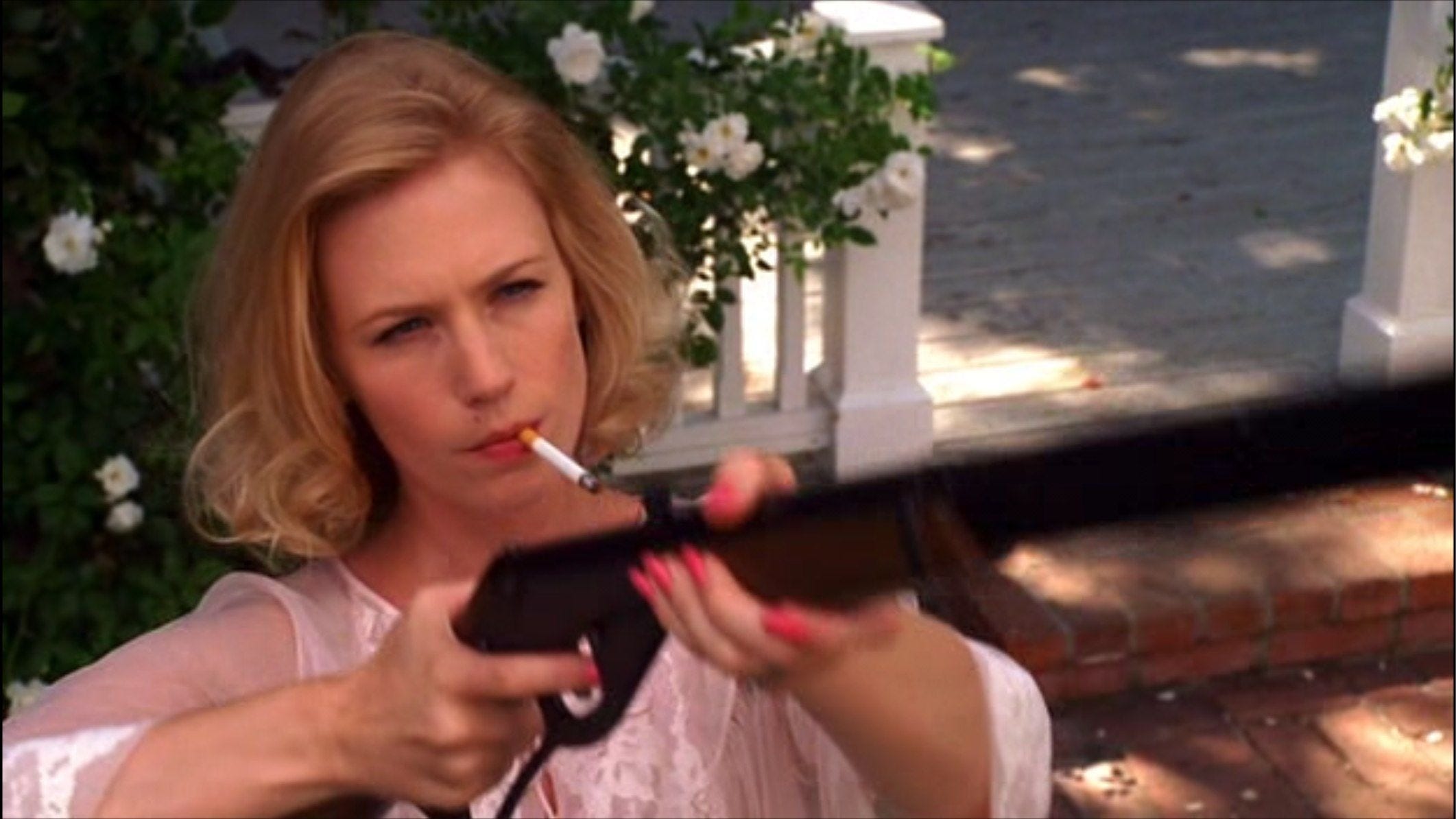
Girl. GIRL. As soon as I saw Betty with the shotgun, I thought "this one's gonna light it up". I was not wrong.
Choosing to stay with the mess is the good stuff. Being "complicated" should be an attribute, not a deterrent. It is indeed where all the flavor is.
You've managed to say so much so succinctly (not at all annoying or preachy BTW), I can only add a big YES to what you've done here. Take the rest of the day off :)
Gah!!!! I loved this. If there was a volume button in my head, by the end of this essay it was cranked at 10.
This! ⬇️
“Instead of settling for the mental equivalent of fast food, we can choose to stay with the mess. To let the commotion exist. To let the contradictions breathe.”
I love life’s messy juxtapositions - I think that’s what adds color to life. That’s what gets us out of the black and white / this or that mentality. There was way more color and nuance in the 50s - even if the television screens didn’t display the color. Funny how so much has changed but yet so much is still the same.