

What's Her Name?
The backstory of the aforementioned Miss Francis and why we get women's history wrong.

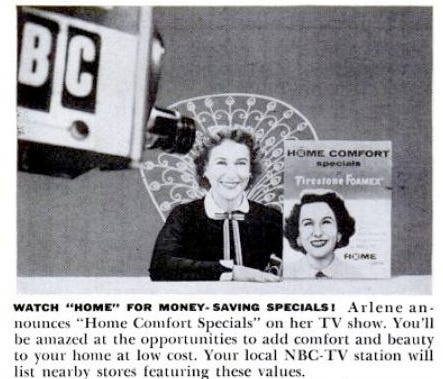
No phenomenon shaped American life in the 1950s more than television. For a nation once plagued by strong regional differences, network television programming blurred these distinctions and worked to forge a national popular culture. A handful of networks produced programs and personalities that influenced viewers and changed the cultural landscape.
Nearly a decade into the “television age,” in 1959, American journalist Mike Wallace declared, “Television burns up writers, comics, and personalities the way a forest fire consumes trees. Frequently all that is left is the smoke and remembrance of things past. An outstanding exception is Arlene Francis. She is fireproof…one of the most successful women in television.” For nearly thirty years, Arlene Francis appeared regularly on television alongside Mike Wallace, Edward R. Murrow, and Jack Paar, and thus helped establish the concept of television talk shows. By 1954, Francis achieved the rare position of being contracted to all three major networks, ABC, CBS, and NBC, a feat which alone should cement her place in media history. Among early television talk-show hosts and personalities, only Edward R. Murrow is represented by more programs at the Museum of Television and Radio. Referring to Francis as “the first lady of television, the July 1954 issue of Newsweek declared hers “the most recognized face in America,” deemed Francis as important as Mamie Eisenhower and Eleanor Roosevelt, and asserted that Arlene was to television viewers what Willie Mays was to baseball fans.
From 1949 to 1975 Arlene Francis maintained an unparalleled career that crossed network boundaries, connecting her to millions of Americans through radio and television. Throughout her long career, Francis maintained a nearly exclusively reserved status for men; yet most television histories fail to mention her impact. The reason for this is a culmination of two points. First, the history of television is primarily written through an institutional lens, concerned with what companies were running or narrating the history of prime-time male stars. Whether from a textual, personal, or national approach, historians have tended to shape American television history solely from the network or executive perspective. Therefore, a great deal of the history of early television is documented not on works of television studies, but rather in studies of the technological history and on the history of related male individuals and the institutions they ran. Such studies offer a wealth of information but are often written outside the necessary critical and cultural discourses. This history is so isolating that that American audiences have forgotten a number of pioneering women.
Sweeping histories and encyclopedias such as The History of Television 1942 to 2000 by Albert Abramson and The Box: An Oral History of Television 1920-1961 by Jeff Kisseloff make significant contributions to the understanding of these men and the early years of television but offer little gender analysis. Gary R. Edgerton’s The Columbia History of American Television, provides a selective history that focuses on network heads David Sarnoff, William Paley, and Pat Weaver, offering a top-down history of the industry. That’s the Way It Is: A History of Television News in America by Charles Ponce de Leon also offers a similar analysis, tracing the history of television news from the grim seriousness of Edward R. Murrow and Walter Cronkite to the snarkiness of Jon Stewart and Bill O’Reilly. By strictly focusing on evening news programming, Ponce de Leon subverts the significance of daytime news programs that were often headed by female personalities.
Because even these nuanced television histories fail to expand across the lines of gender, a great deal of women’s entertainment history is told inaccurately. For years, I’ve read articles and interviews that examine the Tonight show and comedienne Joan Rivers’ impact as the first female host. Yet, these histories fail to mention the dozens of women who tackled late-night before her. Women such as Virginia Graham, Betty White, and Arlene Francis sat in for Jack Paar years before Johnny Carson or Joan Rivers took a seat behind the desk. But the Joan River’s story is more convenient. It’s believable that Joan was bold enough and hard enough to have forced her way into that coveted seat.
Similarly, in 2017 the New York Times reported that actress and comedienne Rose Marie was the first female game show host in American television history. This is false; Francis was the first. But the lack of readily available information about women’s work in the early days of television allows inaccuracies like these to creep into the historical record.
Second, Arlene Francis is an uncomfortable person to examine. Hardly an ideal feminist heroine, she often urged women to stop dominating men and declared that a woman’s main role in life was to cater to and serve her husband. Francis thus seems to have willingly and willfully fulfilled the female stereotype of the 1950s. Yet, if viewed from another angle, her career constitutes an important stepping stone toward a more enlightened era. Her life echoes the constrained and often suffocating lives of white women in the 1950s, while also showcasing the sensitivities, depth, and tensions of the era. As feminist history emerged alongside the Women’s Liberation Movement, figures like Francis were pushed aside because they failed to exemplify the values of a feminist hero. Early feminist historians worked to move women’s stories from outside the confines of their homes, and through this process marginalized the histories of women who existed within and supported domestic spheres. While Arlene Francis and her contemporaries both benefited from and contributed to feminism, in a way, “feminism” is responsible for writing Francis and her achievements out of history.
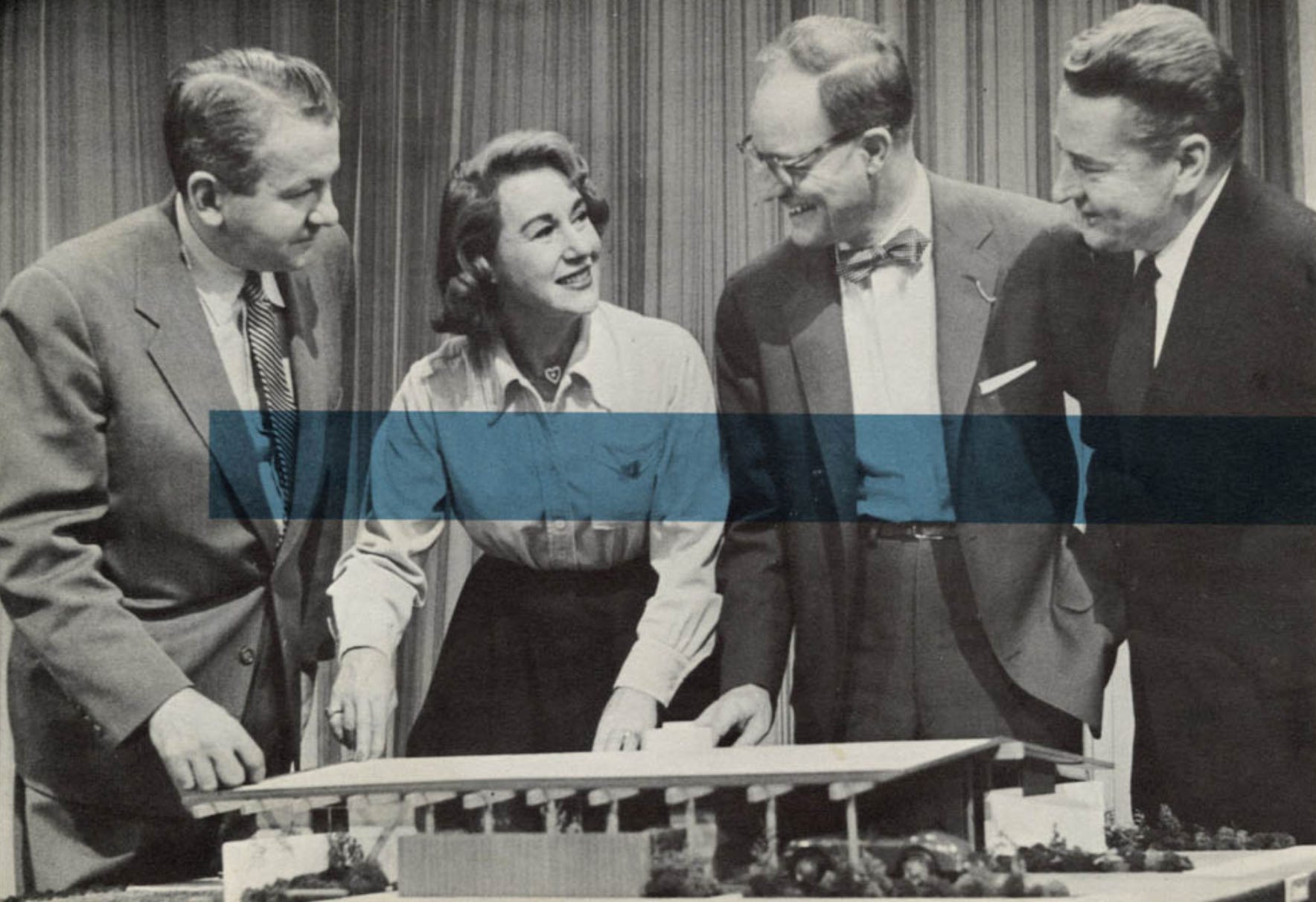
The stories of white, women of the 30s, 40s, and 50s do not echo the realities of their male counterparts. Luckily, historians are no longer dismissing these decades as the “dark ages” for women, arguing that important feminist work happened on both local and national levels. But the “wave” metaphor is reductive and problematic when examining these histories. By restricting 20th-century feminist movements to the first, second, and third waves, it suggests that mainstream feminism is the only kind of feminism there is. It reduces each wave to a stereotype and suggests that there is a sharp division between generations of feminists. Despite this, Sociologist Barbara Ryan has long argued that “the rebirth of feminism can be traced to the family-centered years” of these decades. The women of the 30s, 40s, and 50s were building off of feminism’s first wave and working towards the second, proving that the waves are neither incompatible nor opposed. While Arlene Francis argued against feminism, her existence as a “modern woman” was both influenced by and contributed to the work of the feminist movement.
In this way, Arlene Francis is symbolic of her time and her life offers a nuanced view of the roles of white American women in the 1950s. The world was not a gender paradise before the 1950s, and for most of human history, women have been oppressed and denied fundamental rights. The fifties did not create sexism or rigidly stratified gender roles, but the time did pressure women to an incalculable extent. The increased question of their condition and the development of the Women’s Movements in the sixties muddled women’s understandings of themselves. After investigating how American society constructed and idealized women, it is possible to understand why Francis partook in this idealization process. After all, she heavily participated in magazines and television and radio programs that sought to convince women to adapt and to become this perfect woman. Nevertheless, for Francis, like millions of American women, family life and the role of the perfect wife and dedicated mother seemed both unsatisfying and at times disappointing. But not all women made the transition from committed housewife to militant feminist, and their work can still operate as an example for modern women.
omg at 28 i was lucky not to fall asleep after closing the bar on a weeknight and wake at 3 AM to charred remains of tv dinner let alone deliver this kind of considered thesis.....sometimes tho i did manage to pick around the melted plastic and nibble.....ya gotta eat right?
“It reduces each wave to a stereotype and suggests that there is a sharp division between generations of feminists”. Sadly, the same happened and still happens everywhere, including my country. I so admire the witty way you described history, idealization & humanity here – a very interesting trio. Subscribing. Xo.